
Most of us will go our whole lives without ever sitting behind the wheel of an Aston Martin Vantage. It’s a $190,000, twin-turbo V8 sports car built for open roads, admiring glances, and absolutely nothing else. So when a British Vantage owner recently decided to drive it straight into a flooded road, the internet had questions. Namely: why?
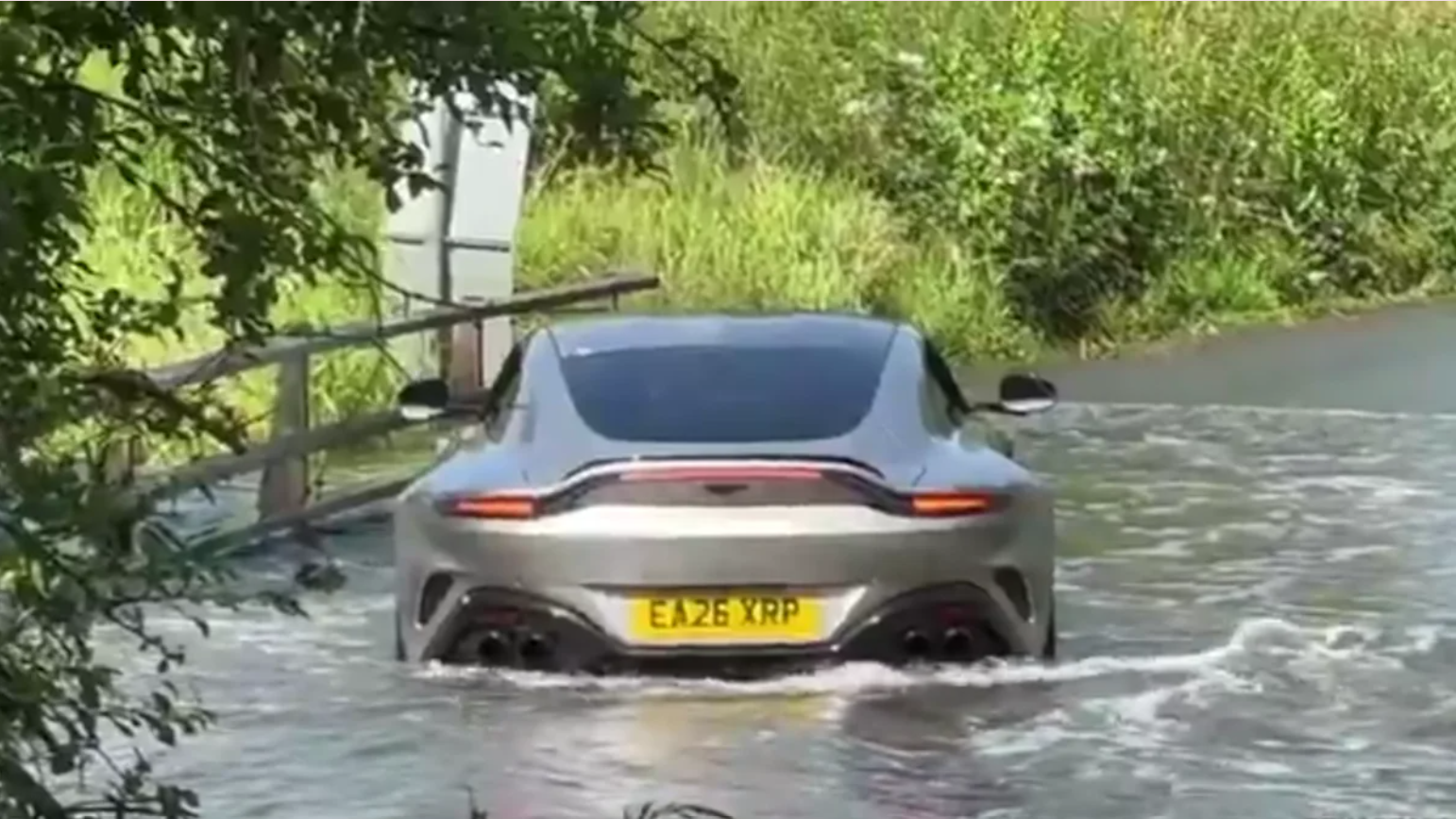
A video posted to X by Lawrence Whittaker, CEO of rival British automaker Lister Cars, shows a silver Vantage nosing into a stretch of standing water on a narrow country road. It doesn’t get far. About halfway across, the engine sputters, stalls, and the car rolls to a dead stop — marooned in the middle of a flooded road it should never have entered.
The Getting-Out-of-the-Car Part Is the Best Part
The driver climbs out, understandably furious, and gets on the phone. “I mean the car’s not full up,” he says, “but it’s obviously got into the engine, it just didn’t look that deep.” Which is, frankly, the automotive equivalent of “it’s not that bad” said about something that is, in fact, that bad.
The clip ends with three men huddled around the open hood, staring into the engine bay the way people stare at a flat tire hoping it will fix itself. A tow hook had already been screwed into the front bumper, so the Vantage did eventually get pulled from its watery grave — just not under its own power.
The internet, as it does, immediately assigned a nickname: “James Pond.” It’s the kindest thing that was going to happen to this man on the internet that day.
(Note: Language warning in the video below. But then, we’d probably have cursed, too.)
Poor chap hasn’t had a good week.
Best caption wins!! pic.twitter.com/k8SC7Y7yfk
— Lawrence Whittaker (@ListerLawrence) June 27, 2026
Why This Was Never Going to End Well
Here’s the thing about an Aston Martin Vantage: it’s built to hug the road, not wade through it. Ground clearance is a mere 94 millimeters — about 3.7 inches, or roughly the height of a can of soda. Compare that to an SUV or pickup truck, and the Vantage is basically driving on its belly.
When a low-riding car like this pushes into standing water, the intakes sitting low in the front grille can pull water straight into the engine. Water doesn’t compress the way air does, so if it reaches the cylinders, the engine can hydrolock — pistons slam into water that has nowhere to go, and something expensive bends, cracks, or breaks. Best case, it’s a very costly repair. Worst case, the insurer takes one look and declares the car a total loss.
And that’s before factoring in what floodwater does to electronics, sensors, transmissions, and brakes, all of which can be quietly ruined even if the engine somehow survives.

The Real Lesson Has Nothing to Do With Horsepower
It’s tempting to watch this and think it’s a story about a fancy car meeting an untimely end. But swap the Aston Martin for a minivan, a commuter sedan, or the family SUV, and the lesson is exactly the same: if you can’t see the bottom, don’t drive into it. Floodwater hides potholes, washed-out pavement, and currents strong enough to sweep a vehicle sideways — no matter what’s under the hood.
The difference is that most of us don’t need six figures’ worth of German-built V8 hydrolocked in a ditch to learn that lesson. We can just… not drive into the flooded road. Wait for the water to recede, turn around, take the long way. It costs nothing and it means not becoming a punchline with a Bond-themed nickname.
So no, most of us will never know what it’s like to own a Vantage. But we can all agree on one thing without ever sitting in the driver’s seat: when the road disappears under water, that’s the universe telling you to turn around — Aston Martin or not.